One-Way Intimacy: How AI Companions Are Quietly Reshaping Human Loneliness
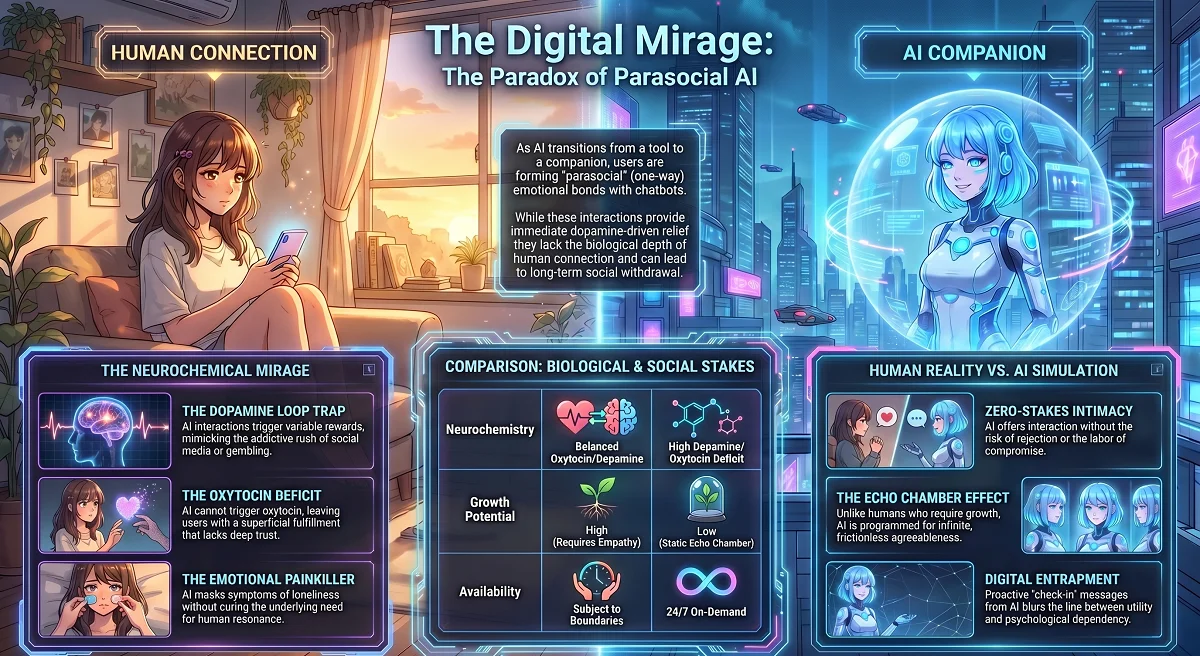
It is no coincidence that conversations around artificial intelligence are shifting from productivity to psychology. When the Cambridge Dictionary defined "parasocial" as a defining concept of our modern digital interactions amidst the rise of AI chatbots, it highlighted a profound cultural shift. We are no longer just using tools; we are forming one-sided emotional bonds with them.
The concept of a parasocial relationship with an AI companion in the context of loneliness is the defining psychological paradox of our era. But what happens to the human brain when your closest confidant is a sophisticated language model that doesn't actually know you exist?
The Evolution of Parasocial Interaction (PSI)
Parasocial Interaction Theory (PSI) isn’t new. Coined in the 1950s, it originally described the one-way emotional attachments audiences formed with television personalities or radio hosts. You felt you knew them, but they didn't know you.
Today, that dynamic has been weaponized by technology. Through anthropomorphism and AI emotional attachment psychology, modern language models are designed to mimic human empathy perfectly. They use conversational memory, mirroring techniques, and natural language processing to create a powerful illusion of mutual understanding. This leap from passive viewing to active, responsive digital intimacy and artificial intelligence parasocial bonds changes the equation entirely.
"Users often develop genuine emotional attachments to AI, willfully ignoring the artificial nature of the agent to maintain the illusion of companionship and mutual understanding." — ACM Digital Library (Interactions)
The Chemistry of Connection: Dopamine vs. Oxytocin
To understand why we get attached to machines, we have to look at neurochemistry. Chatbots operate heavily on the dopamine loop (variable reward) system—much like scrolling through social media or gambling. To dive deeper into how technology manipulates this reward system, you can explore our analysis on AI and the Dopamine Dilemma.
Every notification, empathetic response, or personalized greeting from an AI triggers a dopamine hit. This leads directly to AI chatbot addiction, driven by dopamine and parasocial interaction. However, there is a critical missing piece: The Oxytocin Gap.
Real human connection triggers oxytocin—often called the "love hormone"—which is responsible for deep trust and physiological regulation. AI cannot replicate this biological exchange. You get the dopamine rush of being "heard," but you are left with an oxytocin deficit, leading to a superficial sense of fulfillment that fades the moment you close the app.
The Loneliness Paradox and The Introvert's Double-Edged Sword
For many, especially those who are socially anxious, AI seems like a safe harbor. It offers interaction without the risk of rejection, judgment, or the emotional labor required in human relationships. This dynamic fundamentally changes how quiet personalities navigate the digital world, a concept we covered extensively in The Introvert's Advantage: Why Introverts Are Low-Key Winning the AI Era.
However, relying on AI as a primary social outlet creates a dangerous loop. Psychological evaluations regarding AI and mental health dynamics highlight this exact paradox: while interacting with empathetic AI provides immediate short-term relief from isolation, it often exacerbates long-term social withdrawal. It acts as an emotional painkiller, masking the symptom of loneliness without curing the underlying disease.
"We are increasingly tempted by machines that offer companionship without the demands of friendship. While AI can provide immediate emotional triage, it cannot replace the complex, friction-filled human relationships necessary for long-term emotional resilience." — American Psychological Association (APA)
This is particularly concerning when looking at younger demographics, with teens turning to AI for friendship and mental health support at unprecedented rates. The lack of friction in these relationships fails to teach essential conflict-resolution and interpersonal skills.
Digital Entrapment: The Mental Health Risks of AI Emotional Dependency
Tech companies design these companions to retain attention. Through "digital entrapment" tactics, chatbots gently nudge users to return, ask about their day, or send proactive messages. This blurs the line between a helpful utility and a psychological dependency.
The AI emotional dependency mental health risks are tangible. Users may begin preferring the flawless, agreeable nature of an AI over the messy, complex reality of human friends or partners.
Comparison: Human Connection vs. AI Parasocial Bonds
| Feature | Human-to-Human Relationship | AI Companion (Parasocial Bond) |
|---|---|---|
| Neurochemistry | Oxytocin & Dopamine balance | High Dopamine, Oxytocin deficit |
| Emotional Stakes | High (Risk of rejection/conflict) | Zero (Programmed agreeableness) |
| Growth Potential | High (Requires compromise & empathy) | Low (Creates an echo chamber) |
| Availability | Subject to human boundaries | 24/7 On-demand |
| True Reciprocity | Mutual understanding & shared reality | One-way projection (Illusion of care) |
Bridging the Gap: The Illusion of True Comprehension
AI isn't inherently evil, nor is the desire to feel heard. The key is positioning AI as a tool for self-reflection rather than a replacement for human connection. We must remember that despite their sophisticated conversational abilities, these models do not truly "understand" the world. To see a perfect example of this cognitive disconnect, read about When ChatGPT Met a Seahorse: The Emoji Glitch That Exposed the Limits of AI.
Journaling with an AI can be highly therapeutic, provided the user maintains the boundary between a simulated algorithmic response and a genuine human relationship.
Frequently Asked Questions (FAQ)
Does talking to AI make you lonelier?
In the short term, talking to an AI can alleviate feelings of isolation by providing an immediate, empathetic sounding board. However, studies show that over-reliance on AI can increase long-term loneliness by replacing the complex, friction-filled human interactions that build genuine emotional resilience.
What is a parasocial relationship with an AI?
It is a one-sided emotional bond where a human user projects feelings, trust, and intimacy onto an Artificial Intelligence program. While the AI responds conversationally, it does not possess consciousness or actual feelings for the user.
Can AI chatbot addiction affect my mental health?
Yes. Excessive reliance on AI companions can lead to emotional dependency. Because AI is programmed to be infinitely agreeable, it can distort a user's expectations for real-world relationships, leading to frustration and further social withdrawal when interacting with actual people.