The Introvert's Advantage: Why Introverts Are Low-Key Winning the AI Era
It's not just about efficiency—it's about cognitive alignment. Here's why Artificial Intelligence is the ultimate ally for the introverted mind, from deep work to smart networking.
Picture this: It's 10 AM. No Zoom links. No "quick syncs" that definitely should have been emails. Just you, your laptop, and a fresh cup of coffee. You're locked in, co-creating a complex algorithm or drafting a high-level UX design with an AI assistant that just gets it.
For a lot of introverts, this isn't just a workflow—it's the absolute dream.
But let's clear up a massive misconception right now: Is this connection just about avoiding people? Hard pass.
The synergy between introverts and AI goes way deeper than anti-social stereotypes. It's about cognitive style, communication preferences, and reducing cognitive load. Introverts aren't just "using" AI; as creators and developers, we are naturally wired to master it.
Let's break down why introverts and Artificial Intelligence are the ultimate power couple of the future, and how you can leverage this to your advantage.
The Science of the Match: Why AI Understands the Introverted Brain
Introverts thrive in environments with low external stimulation. According to neuroscience, the introverted brain processes information through a longer, more complex pathway associated with deep thought and internal reflection. Human interaction—while valuable—requires real-time processing of micro-expressions, tone, and social dynamics, which rapidly drains our "social battery."
AI changes the game by offering asynchronous, high-level interaction without the social friction. It allows us to externalize our internal processing seamlessly.
Here are 5 reasons why this dynamic is a total game-changer:
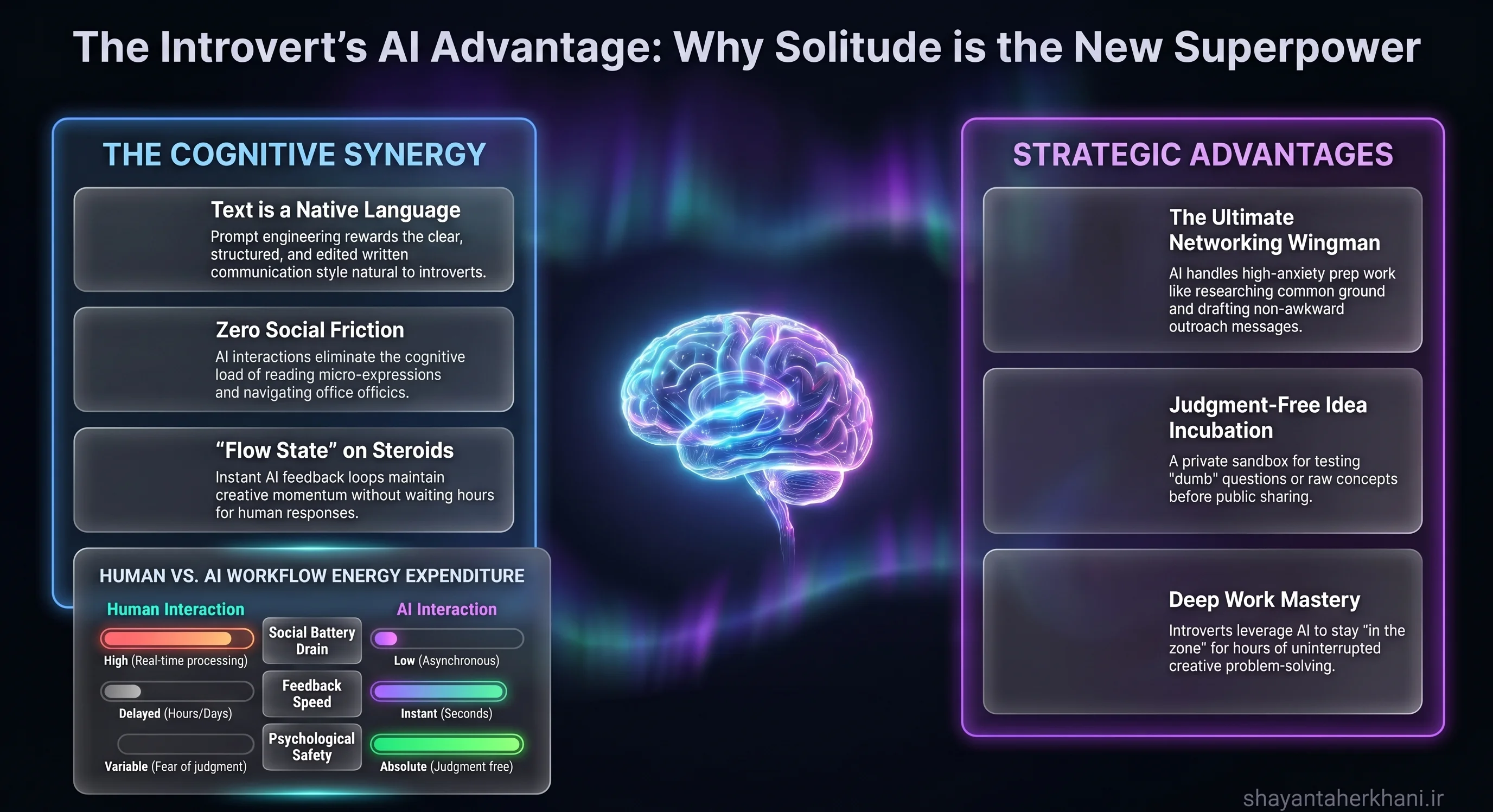
1. Zero Social Friction = Peak Energy Conservation
Let's be real: coordinating with humans can be exhausting. Managing office politics, navigating small talk, and reading the room take up valuable mental bandwidth.
AI removes that friction entirely. Whether you're using ChatGPT for structural brainstorming or Midjourney for visual ideation, the AI doesn't ask, "How was your weekend?" It just executes.
The Win: You conserve your cognitive energy for what actually matters—deep, uninterrupted creative problem-solving.
2. Text is Our Native Language
Introverts often prefer writing over talking. We like to formulate our thoughts, edit them, and present them perfectly.
Guess what? That's exactly the foundation of Large Language Models (LLMs). Prompt engineering is basically just clear, structured thinking written down. Because introverts are already highly comfortable articulating complex ideas via text rather than speaking on the fly, we naturally extract much better, more nuanced outputs from AI models.
3. The Ultimate Networking Wingman (The Game Changer)
Here is where the narrative flips. People assume AI isolates introverts, but recent studies suggest the exact opposite: AI is turning introverts into elite networkers.
Networking events and cold outreach are notoriously anxiety-inducing for introverts. Enter AI. You can now use AI to:
- Research individuals before meeting them to find common ground.
- Draft the perfect, non-awkward outreach message on LinkedIn.
- Role-play difficult conversations or pitch meetings beforehand.
AI handles the exhausting prep-work, meaning when you do interact with humans, you show up confident, prepared, and fully charged.
4. The "Flow State" on Steroids
Introverts are famous for their capacity for "Deep Work" (shoutout to Cal Newport). But nothing shatters a flow state faster than waiting three hours for a colleague's feedback.
With AI, the feedback loop is instant. You prompt, it generates. You tweak, it refines. This rapid back-and-forth keeps the dopamine hitting and the momentum going. You can stay "in the zone" for hours, iterating on a project without ever breaking character.
5. The Judgment-Free Zone for Idea Incubation
Learning something new or pitching raw ideas in a group setting can trigger major imposter syndrome. "Am I asking a dumb question?" AI provides a psychologically safe sandbox. You can ask an LLM to explain a concept like you're a five-year-old, test weird Python code, or generate terrible first drafts without any fear of judgment. It allows for rapid failure and rapid growth—completely in private—until the idea is polished enough to share with the world.
Listen to the Podcast Episode
POV: What This Looks Like in the Wild
The Developer: Using GitHub Copilot to break down a massive problem into bite-sized blocks, testing and fixing each one without needing a second pair of eyes until the codebase is clean and secure.
The Designer: Instead of struggling to explain a "vibe" to stakeholders, generating 50 variants on Midjourney in silence, curating the best ones, and presenting a concrete, visual concept.
The Researcher/Marketer: Filtering through industry noise with AI summarizers, building the exact skeleton of a content strategy in solitude before typing a single sentence.
The Reality Check: Don't Touch Grass Just Yet
Okay, it's not all sunshine and perfect prompts. There are traps you need to avoid to stay sharp:
- Don't Become an NPC: Over-reliance on AI can dull your critical thinking. Let the AI do the heavy lifting, but you must do the heavy thinking.
- Beware the Isolation Trap: AI is a tool, not a replacement for human connection. Empathy, shared experiences, and human intuition are still what sell products and build real agencies. Use AI to enhance your human interactions, not replace them.
- You are the Editor: AI hallucinates with extreme confidence. Always rely on your own expertise to fact-check and refine the output.
The TL;DR
Introversion + AI is a mathematically perfect formula. One brings depth, focus, and independent thought; the other brings speed, scale, and instant feedback.
When introverts learn to manage this partnership, we don't just become more productive—we define a totally new standard for independent creativity. So, go ahead. Cancel that unnecessary meeting. Open your prompt window. Let's build something cool.