AI and the Dopamine Dilemma: Is Technology Rewiring Your Brain’s Happiness?
In an era where algorithms predict our next move, a silent transformation is occurring within the human cranium. While Generative AI offers unprecedented productivity, it is simultaneously interfacing with our neurobiological reward systems in ways we are only beginning to understand. Recent research from Harvard and JAMA suggests a sobering correlation: our digital efficiency might be costing us our biological joy.
The Science of the Shortcut: How AI Hijacks Reward Circuits
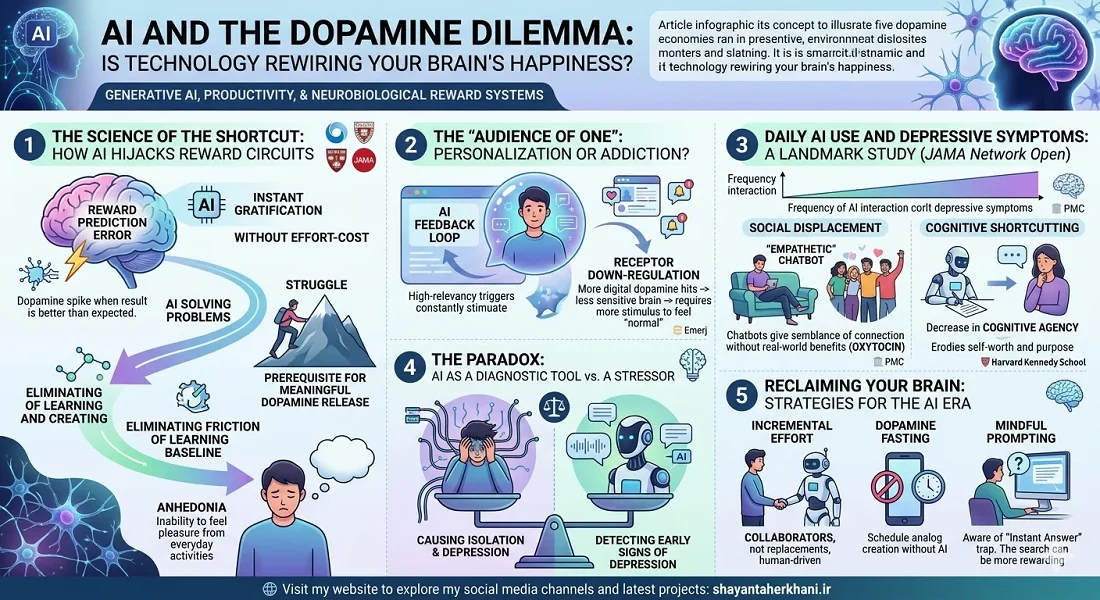
The human brain is wired for “Reward Prediction Error” — the dopamine spike we get when a result is better than expected. According to neuroscientific insights from DeepMind, AI systems are often modeled after these very circuits. However, the problem arises when AI provides instant gratification without the “effort-cost” the brain evolved to expect.
When you use AI to solve every problem, you bypass the struggle. In neurology, the struggle is the prerequisite for a meaningful dopamine release. By eliminating the friction of learning and creating, AI may be lowering our dopamine baseline, leading to a state of “Anhedonia” — the inability to feel pleasure from everyday activities.
The “Audience of One”: Personalization or Addiction?
AI creates a feedback loop tailored to an “Audience of One.” As highlighted by Emerj, this hyper-personalization ensures that the brain is constantly stimulated by high-relevancy triggers. This constant “pinging” of the reward system leads to receptor down-regulation. Simply put: the more hits of digital dopamine you get, the less sensitive your brain becomes to it, requiring more stimulus to feel “normal.”
The Hidden Link: Daily AI Use and Depressive Symptoms
A landmark study published in JAMA Network Open and discussed by Harvard Kennedy School researchers found a significant association between frequent AI interaction and increased depressive symptoms.
The mechanism is twofold:
- Social Displacement: Replacing human-to-human interaction with “empathetic” chatbots provides a semblance of connection without the neurochemical benefits of real-world social bonding (Oxytocin).
- Cognitive Shortcutting: Over-reliance on AI leads to a decrease in “Cognitive Agency.” When we feel we aren’t the authors of our own work or thoughts, our sense of self-worth and purpose — key pillars of mental health — erodes.
The Paradox: AI as a Diagnostic Tool vs. A Stressor
Interestingly, while AI can be a cause of isolation, it is also our best tool for detecting it. Research shows AI can analyze speech patterns to identify early signs of depression. We are entering a paradoxical age where the technology that may be making us unhappy is the same one tasked with diagnosing our sadness.
Reclaiming Your Brain: Strategies for the AI Era
To protect your dopamine system, mental health and AI experts suggest a “Bio-Digital Balance”:
- Incremental Effort: Use AI as a collaborator, not a replacement. Ensure the “heavy lifting” of critical thinking remains human-driven.
- Dopamine Fasting: Schedule periods of “analog creation” where no AI tools are permitted.
- Mindful Prompting: Be aware of the “Instant Answer” trap. Sometimes, the search for the answer is more rewarding to the brain than the answer itself.

Ready to Automate Your Company's Core Workflows?
Stop letting manual data entry, disconnected silos, and sluggish lead responses bottleneck your growth. See how our bespoke AI CRM & ERP systems eliminate operational friction while multiplying conversion rates.